
How Facility Managers Can Reduce Fire Risk Using Smart Fire Systems
Fire safety is no longer limited to installing fire alarms and checking extinguishers once in a while. Modern buildings are becoming larger, more connected, and more complex. They may have electrical equipment, data rooms, warehouses, kitchens, machinery, and hundreds of people working inside them every day. For facility managers, controlling fire risk requires a more proactive approach.
Smart fire systems can help facility managers detect hazards earlier, respond faster, and reduce the impact of a fire. These systems combine modern fire detection, monitoring, suppression, and building security technologies. When properly planned and maintained, they can become an important part of an overall fire safety strategy.
This is especially important in India, where commercial buildings, manufacturing facilities, warehouses, hospitals, hotels, malls, and residential complexes have different fire safety requirements and operating conditions.
Why Traditional Fire Safety Measures Are Not Always Enough
Traditional fire safety equipment still plays an important role. Fire extinguishers, fire hydrants, fire sprinkler systems, fire-rated doors, and alarms are essential in many buildings. However, simply having these systems does not guarantee effective protection.
A fire can spread quickly before someone notices smoke or activates an alarm. A faulty detector may also delay the response. In a large facility, security staff may not immediately know where an alarm has been triggered.
Smart fire systems address some of these challenges by connecting different safety technologies. Instead of treating each system separately, facility managers can monitor important fire safety information from a central platform.
This gives the facility team better visibility and helps them make faster decisions during an emergency.
1. Use Smart Fire Detection for Early Warning
Early detection is one of the most important parts of fire protection.
Modern fire detection systems can use advanced smoke detectors, heat detectors, flame detection, and other sensors to identify signs of a potential fire. Some systems can also provide information about the exact location of an alarm.
For example, if smoke is detected in an electrical room, the facility team can immediately identify the affected area. They do not have to search the entire building to find the source.
Smart monitoring can also help identify unusual conditions before they become serious incidents. Depending on the system, facility managers may receive alerts about temperature changes, equipment faults, or detector problems.
Early warning gives people more time to evacuate and allows the response team to act before the fire spreads.
Also Read: The Future of Fire Detection: AI-Powered Smoke and Heat Sensors
2. Connect Fire Alarms With Central Monitoring
A modern facility may have hundreds of rooms and multiple safety systems. Monitoring everything manually can be difficult.
Connected fire alarms can send information to a central monitoring system. Facility managers and safety officers can see alarm conditions, system faults, and affected zones from a single location.
This can be particularly useful for large offices, factories, warehouses, hospitals, and shopping centres.
A central monitoring system can also help reduce response delays. When an alarm is triggered, the responsible team can quickly identify the location and follow the emergency response procedure.
The goal is not just to generate an alarm. The goal is to provide useful information that helps people take action.
Also Read: The Role of Passive Fire Protection in High-Rise Buildings
3. Integrate Fire Suppression Systems
Detection is only the first step. Once a fire starts, the building also needs an effective suppression strategy.
Depending on the application, facility managers may use automatic sprinkler systems, fire suppression systems, water mist systems, or other suitable technologies.
For example, water mist systems can be considered for applications where fine water droplets are useful for controlling heat and fire. Sprinkler systems may be suitable for many commercial and industrial areas.
The right solution depends on factors such as building design, occupancy, fire load, equipment, and the type of materials stored or used inside the facility.
Smart systems can improve this process by linking detection and suppression. When a confirmed fire condition occurs, the system can trigger the appropriate response according to its design and safety configuration.
4. Protect Critical Areas With Specialised Systems
Not every area of a building has the same level of fire risk.
Server rooms, electrical rooms, kitchens, manufacturing areas, warehouses, and chemical storage spaces may require different protection strategies.
Facility managers should identify high-risk areas during their fire risk assessment. These areas may need additional detectors, dedicated fire suppression systems, or more frequent inspections.
For example, a data centre may require a suppression approach that considers sensitive electronic equipment. A warehouse may need carefully designed sprinkler coverage based on the stored materials and storage arrangement.
Smart monitoring can make it easier to keep track of these critical zones and identify faults before an emergency occurs.
5. Combine Fire Safety With Security Systems
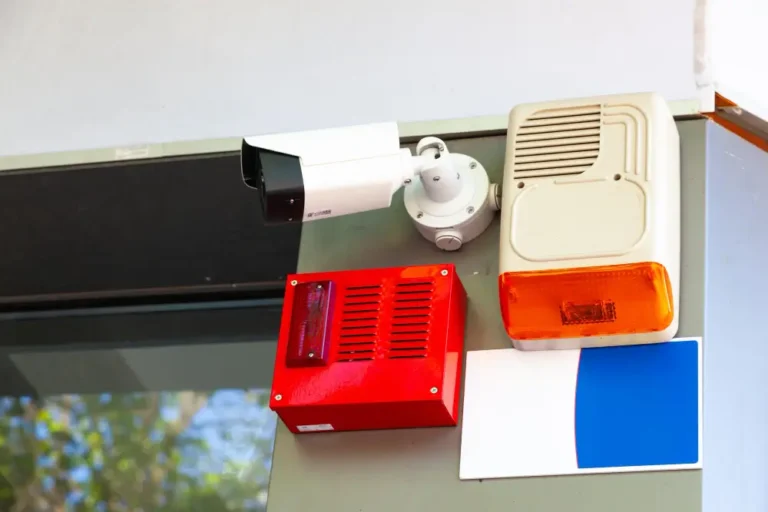
Fire protection and building security are often managed separately, but they can work together.
Access control systems can help facility teams understand who is entering or leaving specific areas. During an emergency, this information can support evacuation and emergency response procedures.
Biometric security systems and other access technologies can also restrict access to sensitive areas such as electrical rooms, control rooms, and equipment spaces.
Integration between security and fire systems can provide a more complete view of an incident. For example, when a fire alarm is activated in a restricted area, security personnel can immediately see the affected zone and follow the appropriate response procedure.
However, any integration must be designed carefully so that life-safety functions remain reliable and compliant with applicable requirements.
6. Do Not Ignore Passive Fire Protection
Smart technology cannot replace basic building protection.
Passive fire protection remains an important part of a complete fire safety strategy. Fire-rated doors, fire-resistant walls, protected shafts, compartmentation, and properly sealed service penetrations can help slow the movement of fire and smoke.
Facility managers should regularly inspect these elements.
A fire-rated door that is damaged, blocked open, or poorly maintained may not perform as intended. Similarly, an unsealed cable or pipe penetration can compromise a fire-rated wall.
Smart monitoring can support facility management, but physical inspections and maintenance are still essential.
7. Use Data to Improve Fire Safety Maintenance
One major advantage of smart fire systems is the amount of information they can provide.
Instead of waiting for equipment to fail, facility managers can monitor system status and maintenance requirements. Repeated alarms, detector faults, battery issues, and other warnings can be reviewed to identify recurring problems.
This supports a more preventive maintenance approach.
Facility managers can create maintenance schedules based on risk and system condition. They can also maintain records of inspections, testing, repairs, and system faults.
Good documentation is valuable during audits and helps the facility team understand how its fire protection systems are performing over time.
8. Train Staff and Safety Officers
Technology alone cannot prevent every fire incident.
Employees, security personnel, maintenance teams, and safety officers need to understand what to do when an alarm occurs.
Training should cover emergency evacuation procedures, alarm response, fire extinguisher use where appropriate, emergency communication, assembly points, and reporting procedures.
Facility managers should also conduct regular fire drills. These exercises can reveal practical problems that may not be visible during normal operations.
For example, an emergency exit may be blocked by equipment, employees may not know the nearest assembly point, or an alarm may not be clearly heard in a particular area.
Finding these problems during a drill is much better than discovering them during a real emergency.
9. Review Fire Risk Regularly
Fire risk changes as a building changes.
A facility may add new machinery, electrical equipment, storage areas, production processes, or office spaces. These changes can create new hazards.
Facility managers should therefore review their fire risk assessment periodically and whenever there is a significant change in building use.
The review should consider detection, suppression, evacuation, passive fire protection, emergency access, electrical safety, housekeeping, and staff training.
The aim is to make fire safety an ongoing process rather than a one-time installation project.
Building a Smarter Fire Safety Strategy in India
For Indian facility managers, choosing the right technology requires more than comparing products. The system should match the building’s risk profile, local requirements, operating environment, and maintenance capabilities.
A practical strategy starts with a detailed risk assessment. Facility managers can then identify where smart detection, automatic suppression, monitoring, access control, and passive protection can provide the most value.
Industry events can also help professionals stay updated with new technologies. The Fire & Security India Expo 2026, for example, provides an opportunity for professionals to explore developments in fire safety, security, detection, and protection technologies.
Events such as a Fire Safety Exhibition in Mumbai can also help facility managers compare solutions and understand how modern systems are being applied across different industries.
Conclusion
Reducing fire risk requires more than installing individual pieces of equipment. Facility managers need a connected and proactive approach that combines detection, suppression, passive protection, security, maintenance, and staff training.
Smart fire systems can provide earlier warnings, faster information, better monitoring, and more effective coordination during emergencies. But technology works best when it is supported by regular inspections, proper maintenance, trained personnel, and a strong fire safety plan.
For modern facilities across India, the future of fire safety is moving toward smarter monitoring and integrated protection. Facility managers who adopt this approach can improve emergency preparedness while creating a safer environment for employees, visitors, assets, and critical operations.