
Fire Safety and Security Systems Planning for Corporate Campuses
Planning fire safety and security systems for corporate campuses is no longer just a compliance task. It is a strategic requirement. Large campuses today include office towers, data centers, warehouses, parking zones, and public interaction spaces. Each area has its own risk profile. A one-size-fits-all approach does not work anymore.
Facility managers and safety officers must design systems that are scalable, integrated, and future-ready. In India, where infrastructure is rapidly expanding, the focus is shifting toward smarter and more resilient safety ecosystems.
Understanding Risk in Large Corporate Campuses
Corporate campuses are complex environments. They operate 24/7 and host thousands of people daily. Risks include fire hazards, unauthorized access, electrical faults, and system failures.
A proper fire detection system is the first step in risk management. Early detection helps prevent major losses. Smoke detectors, heat sensors, and intelligent fire alarms must be installed strategically across all zones.
For example, in IT parks in cities like Bengaluru or Hyderabad, server rooms require highly sensitive fire detection systems. Even a small delay can lead to huge data loss.
Similarly, manufacturing campuses need robust fire suppression systems due to the presence of flammable materials.
Active Fire Protection Systems: The First Line of Defense
Active fire protection systems are designed to respond immediately during an incident. These include fire sprinkler systems, fire hydrant systems, and water mist systems.
Fire sprinkler systems are widely used in corporate buildings. They automatically release water when a certain temperature is reached. In high-rise office buildings, automatic sprinkler systems are essential for quick response.
In large campuses, a fire hydrant system provides external support. Firefighters can connect hoses to hydrants and control large fires effectively. These systems are critical in industrial zones and logistics parks.
Water mist systems are gaining popularity in India. They use less water but are highly effective in controlling fires, especially in areas with sensitive equipment like data centers and electrical rooms.
Fire Suppression Systems for Specialized Areas
Not all fires can be controlled with water. In areas like server rooms, control panels, or labs, water can cause more damage.
Here, fire suppression systems using gas or chemical agents are used. These systems detect fire and release agents that suppress flames without harming equipment.
Corporate campuses often deploy clean agent systems in IT infrastructure zones. This ensures business continuity even during emergencies.
Passive Fire Protection: The Silent Shield
While active systems respond to fire, passive fire protection helps contain it. This includes fire rated doors, fire-resistant walls, and compartmentalization.
Fire rated doors prevent fire and smoke from spreading between sections. This gives occupants more time to evacuate safely.
In large office campuses, proper zoning is critical. Passive fire protection ensures that even if a fire starts in one area, it does not spread rapidly across the building.
This approach is widely used in metro stations, airports, and commercial complexes across India.
Also Read: How FSIE Mumbai Connects Fire Exhibitors with Decision Makers
Integrated Security Systems for Corporate Safety
Fire safety cannot work in isolation. It must be integrated with security systems.
Access control systems play a key role in managing entry and exit points. These systems restrict unauthorized access and help track movement within the campus.
Biometric security solutions are increasingly being used in corporate environments. Fingerprint and facial recognition systems ensure that only authorized personnel can access sensitive areas.
In case of an emergency, these systems can also assist in evacuation tracking. Facility managers can quickly identify who is inside the building.
Role of Safety Officers and Facility Managers
Safety officers and facility managers are at the center of campus safety planning. Their role is not limited to installation. They are responsible for maintenance, audits, and training.
Regular fire drills must be conducted. Employees should know evacuation routes and emergency procedures.
Facility managers must also ensure that all systems, including fire alarms and smoke detectors, are tested periodically.
In large campuses, centralized control rooms are used. These rooms monitor all safety and security systems in real time.
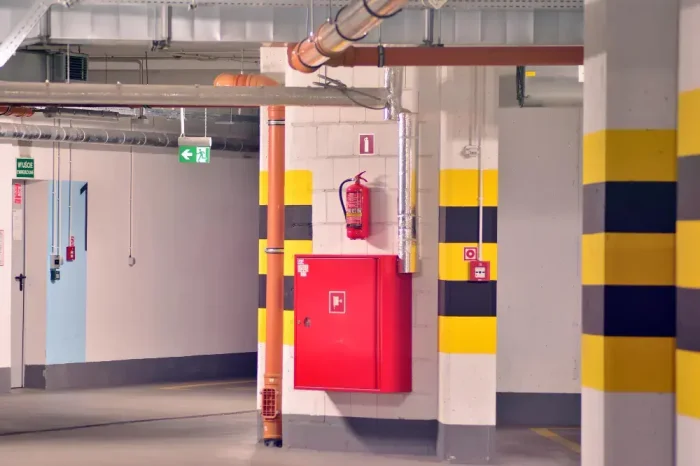
Smart Technology and Automation in Fire Safety
Modern corporate campuses are adopting smart technologies. IoT-enabled fire detection systems can send alerts instantly to control rooms and mobile devices.
AI-based analytics can detect unusual patterns, such as temperature spikes or unauthorized access.
Integration of fire detection systems with building management systems (BMS) allows automated responses. For example, elevators can be grounded, HVAC systems can be shut down, and emergency lighting can be activated during a fire.
This level of automation reduces response time and enhances safety.
Real-World Use Cases in India
Compliance and Standards in India
Fire safety planning must align with Indian standards such as NBC (National Building Code) and guidelines from local fire authorities.
Corporate campuses must obtain fire NOCs and conduct regular inspections. Non-compliance can lead to penalties and operational disruptions.
Facility managers must stay updated with changing regulations. Participation in industry events like Fire & Security India Expo 2026 helps professionals understand the latest compliance requirements and technologies.
Planning for Future Expansion
Corporate campuses are dynamic. They expand over time. Safety systems must be designed to scale.
Modular fire detection systems allow easy expansion. Similarly, access control systems should support additional entry points and users.
Future-ready planning also includes adopting sustainable solutions. Water-efficient fire suppression systems and energy-efficient alarms are becoming important.
Importance of Training and Awareness
Even the best systems fail without proper human response. Training employees is essential.
Staff should know how to use fire extinguishers and follow evacuation procedures. Safety officers must conduct regular awareness sessions.
Clear signage, emergency maps, and communication systems play a key role in guiding people during emergencies.
Why Industry Exposure Matters
Planning fire and security systems requires continuous learning. Technologies are evolving rapidly.
Attending events like Fire Safety Exhibition 2026 India and other fire and security expo in India helps professionals explore new solutions.
These exhibitions bring together fire exhibitors, security experts, and technology providers under one roof.
For facility managers, such platforms offer insights into best practices, case studies, and innovative products.
Conclusion
Fire safety and security planning for corporate campuses is a multi-layered process. It requires a combination of active and passive protection, advanced technology, and skilled management.
From fire alarms and sprinkler systems to biometric security and access control systems, every element plays a critical role.
In India’s fast-growing infrastructure landscape, corporate campuses must adopt integrated and future-ready safety solutions.
Facility managers and safety officers must take a proactive approach. They should invest in modern systems, ensure compliance, and stay updated with industry trends.
Ultimately, a well-planned fire and security system not only protects assets but also saves lives.