
What Fire Protection Systems Are Required in Oil Refineries and Petrochemical Plants?How AI Is Transforming Fire Safety in the Oil and Gas Industry
Oil refineries and petrochemical plants handle large quantities of flammable liquids, combustible gases, and hazardous chemicals. A small leak or spark can lead to a major fire or explosion. These incidents can damage equipment, disrupt production, harm workers, and affect nearby communities.
For this reason, industrial facilities need a complete fire protection strategy. It should combine early detection, automatic suppression, firefighting equipment, passive fire protection, and emergency response procedures.
In India, fire protection requirements depend on the type of facility, the materials handled, the process design, and the applicable regulations. Standards and guidelines from organizations such as the Oil Industry Safety Directorate (OISD), the National Building Code of India (NBC), and relevant Indian Standards may apply, along with requirements from the Petroleum and Explosives Safety Organisation (PESO) and local fire authorities.
So, what fire protection systems are required in oil refineries and petrochemical plants? The answer depends on the site’s fire risk assessment, but several systems are commonly essential.
1. Fire Detection and Alarm Systems
A fire detection system helps identify a fire or hazardous condition before it spreads. Early detection gives operators more time to isolate equipment, activate emergency procedures, and protect personnel.
Oil refineries need detection equipment suited to their operating environment. Conventional smoke detectors may not work well in every process area because of dust, vapours, high temperatures, or outdoor conditions.
Common detection technologies include:
- Flame detectors: Detect ultraviolet (UV), infrared (IR), or combined UV/IR radiation from flames.
- Heat detectors: Identify abnormal temperature increases in selected areas.
- Smoke detectors: Detect smoke in suitable enclosed spaces, control rooms, offices, and electrical rooms.
- Gas detectors: Identify flammable gas leaks before they reach dangerous concentrations.
- Linear heat detection: Monitors temperature changes along cables, conveyors, and selected industrial equipment.
Fire alarms provide audible and visual warnings when a fire or other defined emergency condition occurs. In large facilities, alarm systems should integrate with the control room and emergency response arrangements.
For example, a flame detector near a pump handling flammable hydrocarbons may trigger an alarm and initiate a predefined emergency response. Depending on the approved design, it may also activate a local suppression system or initiate an emergency shutdown sequence.
The key is to select detection equipment based on the actual hazard, not simply install the same devices throughout the facility.
Also Read: The Future of Fire Detection: AI-Powered Smoke and Heat Sensors
2. Fire Hydrant Systems and Fire Water Networks
A fire hydrant system is a major part of industrial firefighting infrastructure. It provides water through a network of pipes, hydrants, monitors, and hose connections.
Oil refineries and petrochemical plants often have extensive outdoor process areas. Fixed fire water networks allow emergency teams to reach different sections of the facility without relying only on portable equipment.
A typical fire water system includes:
- Fire water storage tanks or other approved water sources.
- Main and standby fire pumps, as required by the design.
- Hydrants positioned at suitable locations.
- Fire hoses, hose boxes, and associated connections.
- Fixed or mobile water monitors.
- Ring mains designed to maintain the required flow and pressure.
Water monitors can deliver large volumes of water to cool storage tanks, vessels, and nearby equipment. This cooling action can help limit fire escalation and reduce the risk of heat-related failure.
However, water is not suitable for extinguishing every type of fire. Applying water directly to certain burning hydrocarbon liquids can spread the fuel or worsen the incident. The correct firefighting method depends on the material involved.
The system must therefore be designed around credible fire scenarios, water demand, equipment layout, and emergency access. Safety officers should also arrange regular inspections and flow tests to verify that the system remains operational.
Also Read: The Role of Passive Fire Protection in High-Rise Buildings
3. Fire Suppression Systems
Fire suppression systems are designed to control or extinguish a fire using an appropriate extinguishing agent. The right solution depends on the fuel, equipment, operating conditions, and potential consequences of a fire.
Different areas of a refinery may require different suppression technologies.
Foam-Based Fire Suppression Systems
Foam systems are widely used for selected flammable-liquid hazards. They can be suitable for hydrocarbon storage tanks, loading areas, bunds, and other locations identified through fire risk assessment.
Foam forms a blanket over the burning liquid. This helps suppress flammable vapours and reduce the supply of oxygen to the fire.
The system may use fixed foam chambers, foam monitors, foam-water sprinklers, or other engineered arrangements.
The foam concentrate must be compatible with the fuel and the selected application method. Environmental restrictions and the phase-out of certain fluorinated foam products should also be considered when selecting equipment.
Gas-Based Fire Suppression Systems
Gas-based systems are often used in enclosed rooms containing sensitive equipment. Examples include electrical rooms, control rooms, and selected server or instrumentation spaces.
These systems use an approved extinguishing gas to control a fire without leaving the residue associated with some other agents.
The room must be suitable for the selected system. Designers need to consider enclosure integrity, agent concentration, pressure relief, ventilation shutdown, and personnel safety.
Water Mist Systems
Water mist systems release very small water droplets to control heat and, in suitable applications, reduce the spread of fire.
They may be considered for selected machinery spaces, enclosed equipment areas, and other hazards where testing and engineering support their use.
Water mist is not a universal replacement for conventional sprinklers or foam systems. Its suitability must be confirmed for the specific fuel, fire scenario, and equipment arrangement.
4. Automatic Sprinkler Systems
Automatic sprinkler systems help control fires without waiting for someone to operate the equipment manually. Individual sprinkler heads typically activate when exposed to a specified temperature.
They are commonly considered for suitable buildings and enclosed areas within refinery and petrochemical facilities.
Examples include:
- Administrative and support buildings.
- Warehouses and selected storage areas.
- Workshops and maintenance buildings.
- Certain enclosed industrial spaces.
- Other occupancies where the applicable design standard requires or supports sprinklers.
Sprinkler systems can reduce fire growth and limit damage. However, they must be designed for the actual hazard and water demand.
Standard building sprinklers should not automatically be assumed suitable for open process units or flammable-liquid hazards. Such areas may require dedicated water spray, foam-water, or other engineered systems.
Facility managers should ensure that sprinkler heads, control valves, alarms, and water supplies are inspected and maintained. Valves must remain in their intended operating position, and any impairment should be managed through an approved procedure.
AI can also move fire safety from reactive monitoring to predictive monitoring.
5. Fixed Water Spray and Deluge Systems
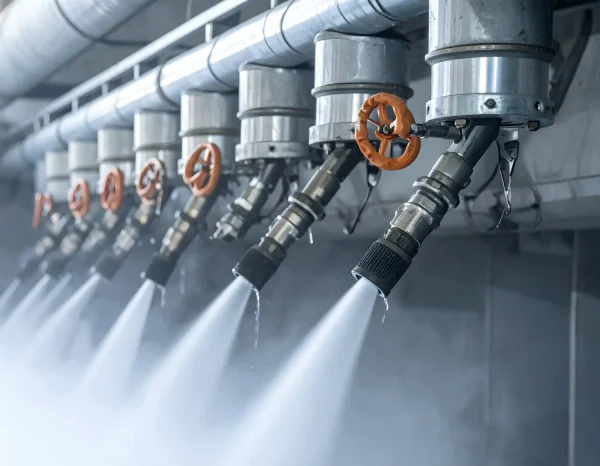
Fixed water spray and deluge systems are important options for protecting selected high-risk industrial equipment.
A deluge system uses open nozzles connected to a supply controlled by a deluge valve. When the system activates, water flows through the connected nozzles across the protected area.
These systems may be installed around:
- Selected pressurised vessels.
- Hydrocarbon processing equipment.
- LPG storage and handling facilities.
- Equipment exposed to significant radiant heat.
- Other assets identified by the fire risk assessment.
The primary objective is often equipment cooling rather than direct extinguishment. Cooling can help protect vessels and structural components from excessive heat.
For example, a fire near a pressurised hydrocarbon vessel can expose the vessel to intense heat. An appropriately designed water spray system may reduce the risk of catastrophic failure by cooling the exposed surfaces.
System design must account for the equipment geometry, nozzle coverage, water supply, activation method, drainage, and possible interaction with other firefighting systems.
6. Passive Fire Protection
Active systems detect or respond to a fire. Passive fire protection helps prevent fire and heat from spreading through a facility.
This protection is especially important in refineries because fires can affect structural supports, cable routes, process equipment, and escape routes.
Common passive fire protection measures include:
- Fire-resistant coatings on selected structural steel.
- Fire-rated walls and compartmentation.
- Fire-rated doors and suitable fire stopping.
- Protection of critical cable routes.
- Fire-resistant separation between designated areas.
- Fireproofing for selected equipment supports and structural members.
Passive fire protection should be based on the fire scenarios and required survival time for critical assets.
For example, fireproofing may protect the structural supports of an elevated pipe rack or a critical vessel. This can help preserve structural integrity during a fire and provide additional time for emergency response.
Fire-rated doors are also important in buildings where they maintain the integrity of fire compartments. They should not be obstructed or left open where this would compromise their intended function.
Regular inspection is necessary because damaged coatings, unsealed penetrations, or poorly maintained doors can weaken the overall protection strategy.
7. Emergency Shutdown and Fire Protection Integration
Fire protection is most effective when it works alongside process safety systems. A refinery should not depend on alarms and firefighting equipment alone.
Emergency shutdown (ESD) systems help place selected equipment or processes into a safer condition during an emergency. Depending on the approved design, this may involve stopping pumps, closing isolation valves, or shutting down selected process operations.
A well-designed system may integrate:
- Fire and gas detection.
- Control room alarms.
- Emergency shutdown systems.
- Automatic suppression systems.
- Ventilation and equipment shutdown controls.
- Emergency communication systems.
For example, a gas detector may identify a flammable gas leak near a compressor. The control system can alert operators and initiate predefined actions where required by the safety design.
Fire detection and emergency shutdown systems serve different purposes. Their functions, logic, and interfaces should be clearly defined and tested.
Safety officers should also review whether the system remains effective during power failures, communication interruptions, and other credible emergency conditions.
8. Portable Fire Extinguishers and Mobile Firefighting Equipment
Fixed fire protection systems are essential, but portable equipment also plays an important role in industrial safety.
Fire extinguishers allow trained personnel to respond to small fires when it is safe to do so. They should be selected according to the expected fire class and the hazards present.
Common equipment includes:
- Dry chemical powder extinguishers for suitable flammable-liquid and gas fire scenarios.
- Carbon dioxide extinguishers for selected electrical equipment and other compatible hazards.
- Foam extinguishers for appropriate flammable-liquid risks.
- Water-based extinguishers for suitable ordinary combustible materials.
- Mobile firefighting units for large industrial areas and specialised emergency response.
The choice of extinguisher must consider the fuel, electrical hazards, environmental conditions, and the risk to the operator.
Extinguishers should be easy to access, correctly labelled, inspected, and maintained. Workers must receive training on when to use them and when to evacuate instead.
Large refineries also need trained emergency response teams with suitable protective clothing, breathing apparatus, rescue equipment, and firefighting appliances.
9. Fire Protection for Electrical Rooms and Control Rooms
Electrical rooms, instrumentation rooms, and control rooms support critical refinery operations. A fire in these areas can affect production, monitoring, communication, and emergency response.
These spaces may require a combination of smoke detection, fire alarms, suitable suppression systems, fire-resistant construction, and controlled ventilation.
The exact combination depends on the room’s function and the equipment installed inside it.
For example, a control room containing sensitive electronic equipment may benefit from an engineered clean-agent suppression system. A suitable detection arrangement can provide an early warning before a fire causes extensive damage.
Designers should consider the following factors:
- Equipment heat loads and ignition sources.
- Cable penetrations and fire stopping.
- Room enclosure integrity.
- Personnel occupancy and safe evacuation.
- Power supply reliability.
- Protection of critical control and safety functions.
Fire suppression systems must be designed to protect both personnel and equipment. Audible and visual warnings, appropriate release delays where required, and clear evacuation procedures are important for occupied spaces.
10. Gas Detection and Hazardous Area Safety
Gas detection is especially important in facilities that handle LPG, hydrogen, methane, and other flammable gases.
A gas leak may create an explosive atmosphere before a flame appears. Detecting the leak early allows operators to investigate, isolate the source, and take protective action.
Fixed gas detectors should be positioned according to the gas properties, likely leak locations, ventilation patterns, and equipment layout. Detector placement should not rely on a simple rule that all gases rise or all gases sink.
For example, lighter-than-air gases and heavier-than-air vapours can behave differently. Air movement, temperature, obstructions, and release pressure can also affect gas dispersion.
A complete hazardous-area safety strategy may include:
- Fixed flammable gas detectors.
- Portable gas monitors for selected tasks.
- Certified electrical equipment suitable for the hazardous area.
- Safe isolation and shutdown arrangements.
- Leak prevention and maintenance procedures.
- Permit-to-work controls for high-risk activities.
Access control systems can also help restrict entry into hazardous or restricted zones. However, access control is a supporting security measure, not a replacement for gas detection, process isolation, or fire protection.
11. Security Systems and Emergency Access Control
Industrial fire safety also depends on effective site security. Unauthorised access, tampering, and poor control of hazardous areas can increase operational risks.
Refineries may use access control systems, CCTV surveillance, visitor management, and other security measures to protect critical assets.
Biometric security may be suitable for selected restricted areas where identity verification is necessary. The choice of technology should consider operational requirements, emergency egress, privacy, and reliability.
Security procedures must never prevent people from escaping during a fire. Emergency exits, evacuation routes, and access for firefighting teams must remain available.
Facility managers should coordinate security staff with emergency response teams. During an incident, responders need clear access to the affected area, while evacuation routes must remain unobstructed.
12. How to Select the Right Fire Protection System
There is no single fire protection package suitable for every refinery or petrochemical plant. The right solution depends on the facility’s hazards and operating conditions.
Before selecting equipment, the engineering team should assess:
1. Fire and explosion hazards: Identify flammable liquids, combustible gases, chemical hazards, ignition sources, and potential release points.
2. Plant layout: Review equipment spacing, access roads, storage tanks, process units, control rooms, and emergency escape routes.
3. Fire scenarios: Evaluate credible events, including pool fires, jet fires, flash fires, and equipment exposure to radiant heat.
4. Detection and response requirements: Decide which hazards need flame detection, gas detection, heat detection, smoke detection, or automatic system activation.
5. Water and suppression capacity: Confirm that the fire water network, pumps, storage, and suppression systems can meet the applicable design demand.
6. Regulatory compliance: Identify the applicable Indian regulations, OISD standards, relevant Indian Standards, approved engineering codes, and local authority requirements.
7. Inspection and maintenance: Establish testing schedules, maintenance responsibilities, spare-parts requirements, and procedures for managing system impairments.
The design should be reviewed by qualified fire protection and process safety professionals. Any change in equipment, plant layout, fuel type, or operating conditions should trigger a review of the affected protection measures.
13. Fire Protection Standards and Regulations in India
Oil refineries and petrochemical plants in India must identify and follow the statutory requirements that apply to their specific installations.
The Oil Industry Safety Directorate publishes industry standards covering fire protection, process safety, equipment layout, and related subjects. OISD-STD-116 is specifically concerned with fire protection facilities for petroleum refineries, petrochemical complexes, and oil and gas processing plants. The current-edition listing identifies a June 2025 edition. Review the official OISD standards list.
The Petroleum Rules, 2002, also contain fire control provisions for certain crude oil refineries. Rule 172 addresses firefighting services, fire water supplies, hydrants, and personnel training. The applicable statutory wording and approvals should be checked for the facility in question. Read the official Petroleum Rules information from PESO.
Other requirements may include the National Building Code of India, relevant Indian Standards, environmental requirements, and local fire authority conditions, depending on the facility and the system involved.
Important: Not every fire protection system listed in this article is mandatory at every site. The final design must follow the applicable regulations, current standards, hazard assessment, and approved engineering requirements.
Conclusion
Oil refineries and petrochemical plants need a coordinated approach to fire prevention, detection, suppression, and emergency response. Fire alarms, fire detection systems, fire hydrant systems, foam-based suppression, automatic sprinklers, fixed water spray, and passive fire protection can all play important roles.
Gas detection, emergency shutdown systems, portable firefighting equipment, and secure emergency access provide additional layers of protection.
The most effective strategy combines the right equipment with reliable maintenance, trained personnel, and regular emergency drills. For facility managers and safety officers, the goal is not simply to install fire protection systems. It is to ensure that every system is suitable for the hazard and ready to perform when needed.
Industry professionals can also explore emerging fire detection technologies, suppression equipment, and industrial safety solutions at the Fire & Security India Expo 2027 in New Delhi. Industry exhibitions provide opportunities to compare technologies, meet manufacturers, and learn about developments in fire safety and security.
FAQs
1. Which fire protection systems are required in oil refineries?
Common systems include fire water networks, hydrants, fire detection and alarms, suitable suppression systems, portable firefighting equipment, and passive fire protection. The exact requirements depend on applicable regulations and the facility’s risk assessment.
2. Are fire sprinkler systems mandatory in petrochemical plants?
Sprinkler requirements depend on the building occupancy, hazard classification, applicable standards, and approved design. Some areas may need automatic sprinklers, while process units or flammable-liquid hazards may require other engineered protection systems.
3. Why are foam suppression systems used in oil refineries?
Foam can suppress fires involving suitable flammable liquids by covering the fuel surface and reducing the release of flammable vapours. The foam type and application method must match the fuel and the identified fire scenario.
4. What is the role of a fire hydrant system in a refinery?
A fire hydrant system provides water access for emergency teams through hydrants, hoses, monitors, and a connected fire water network. It supports firefighting and equipment cooling during suitable fire scenarios.
5. Which Indian standard covers fire protection in oil refineries?
OISD-STD-116 addresses fire protection facilities for petroleum refineries, petrochemical complexes, and oil and gas processing plants. The applicable edition and related statutory requirements should be verified through official sources.
6. How often should refinery fire protection systems be inspected?
Inspection and testing frequency depends on the equipment, applicable standards, manufacturer guidance, and site procedures. Facilities should maintain documented schedules, test results, defect records, and corrective actions.
7. Where can industry professionals explore new fire safety technologies in India?
Professionals can attend relevant fire and security exhibitions to explore detection, suppression, firefighting equipment, and industrial security solutions. The Fire & Security India Expo is one industry platform to consider when planning professional networking and technology evaluation.