
Fire Safety Planning for Net-Zero and Green Buildings
Green buildings are changing the way commercial, residential, industrial, and institutional spaces are designed. Energy-efficient lighting, solar power, smart building controls, electric vehicles, battery storage, water-saving systems, and sustainable construction materials are becoming more common across India.
These technologies can reduce energy use and operating costs. They can also support long-term sustainability goals. But a green building still needs a strong fire safety strategy.
In some cases, sustainable technologies can introduce new fire risks. Solar panels, battery energy storage, electric vehicle charging stations, high-performance insulation, and modern building materials all require careful consideration during fire safety planning.
For building owners, safety officers, facility managers, architects, and project teams, the goal should be simple: improve environmental performance without compromising life safety.
What Makes Fire Safety Different in Green Buildings?
A green building is not automatically a safer building. Its fire safety requirements depend on its design, occupancy, materials, electrical systems, equipment, and emergency arrangements.
Modern energy-efficient buildings may use advanced systems that were less common in traditional buildings. For example, a building may have rooftop solar panels, lithium-ion battery storage, EV charging points, automated building management systems, and highly insulated walls.
Each system can affect fire prevention or emergency response in a different way.
The challenge is to consider fire safety from the planning stage instead of treating it as an installation to be completed at the end of construction.
A well-designed fire safety strategy should address three areas:
- Preventing fires wherever possible
- Detecting and controlling fires quickly
- Protecting occupants and supporting safe evacuation
This approach combines active and passive fire protection with emergency planning and regular maintenance.
Solar Power and Fire Safety
Solar photovoltaic systems are increasingly being installed on commercial buildings, factories, warehouses, schools, and residential properties in India.
Solar power can reduce dependence on conventional electricity. However, electrical faults, damaged cables, poor installation, overheating, and equipment failures can create fire hazards.
Solar installations should therefore be included in the building’s overall fire safety plan.
Electrical equipment should be installed and maintained according to applicable requirements. Cables should be properly protected, and access should be maintained around important equipment.
Fire response teams should also know where solar panels, inverters, isolators, and other related equipment are located.
A common mistake is to consider the rooftop solar system separately from the building’s emergency plan. Instead, it should be treated as part of the complete electrical and fire safety infrastructure.
Also Read: The Future of Fire Detection: AI-Powered Smoke and Heat Sensors
Battery Energy Storage Requires Special Attention
Battery energy storage is becoming more important as buildings adopt renewable energy and backup power solutions.
Lithium-ion batteries are widely used because of their energy density and efficiency. However, thermal runaway can create serious fire challenges. A damaged or overheating battery can generate significant heat and may release flammable gases.
For buildings using battery storage, fire safety planning should consider:
- Location of battery storage areas
- Ventilation requirements
- Temperature monitoring
- Electrical protection
- Fire detection
- Emergency isolation
- Access for emergency responders
- Manufacturer recommendations
- Maintenance and inspection procedures
The correct fire protection approach depends on the battery technology, installation size, building design, and risk assessment.
There is no single solution that works for every battery installation.
Also Read: The Role of Passive Fire Protection in High-Rise Buildings
Fire Detection in Energy-Efficient Buildings
Early detection is one of the most important parts of a modern fire safety strategy.
Advanced buildings may have complex layouts, enclosed service areas, electrical rooms, battery rooms, data centres, and other spaces where a fire may develop before occupants notice visible signs.
A suitable fire detection system can provide an early warning and support faster emergency response.
Depending on the building and risk level, the system may include fire alarms, smoke detectors, heat detection, manual call points, and other monitoring technologies.
The detection strategy should be based on the actual risk rather than simply installing the same equipment throughout the building.
For example, an electrical room may require a different detection approach from a normal office area. A battery storage room may require additional monitoring based on the technology being used.
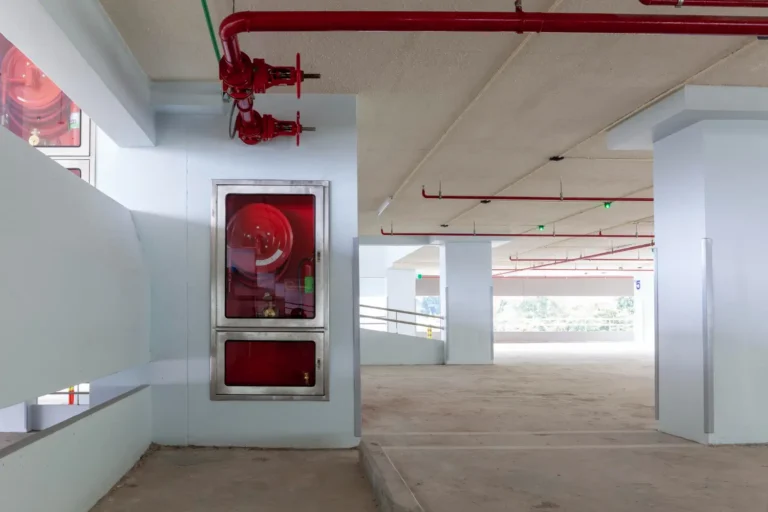
Fire Suppression Systems for Green Buildings
Fire suppression systems can help control a fire before it spreads and can reduce damage to buildings and equipment.
Traditional water-based systems remain important for many building types. Fire sprinkler systems and automatic sprinkler systems can provide effective fire control when properly designed, installed, tested, and maintained.
However, some specialised areas may require other approaches.
Data centres, electrical rooms, archives, laboratories, and sensitive equipment areas may need carefully selected suppression solutions. In certain applications, water mist systems or other specialised systems may be considered.
The right solution depends on the room, fire load, equipment, occupancy, and applicable standards.
Green building design should never lead to a reduction in necessary fire protection simply to save water or resources. Instead, designers should look for solutions that provide effective protection while using resources responsibly.
Passive Fire Protection Still Matters
Technology gets a lot of attention in modern buildings, but passive fire protection remains a fundamental part of fire safety.
Passive protection is built into the structure of a building. It helps restrict fire and smoke movement and can provide occupants with more time to evacuate.
Important elements may include fire-rated walls, fire rated doors, protected shafts, fire stopping, compartmentation, and fire-resistant construction.
For example, cable and pipe penetrations through fire-rated walls need appropriate fire-stopping treatment. If these openings are left unprotected, fire and smoke can travel between compartments.
Sustainable construction materials should therefore be evaluated not only for energy performance but also for their fire behaviour and suitability for the intended application.
A building cannot be considered truly sustainable if a fire can spread rapidly because fire-resistant construction has been compromised.
Fire Rated Doors and Safe Evacuation
Fire rated doors are another important part of building fire protection.
They can help limit the movement of fire and smoke between different areas when correctly installed and maintained.
In a green building, emergency exits should remain easy to identify and access. Energy-efficient design should never interfere with evacuation routes.
Building managers should regularly check that:
- Exit routes remain clear
- Fire doors are not blocked or wedged open
- Emergency lighting works correctly
- Exit signs remain visible
- Staircases are accessible
- Evacuation plans are displayed where required
- Occupants understand emergency procedures
Smart building systems can support emergency management, but they should not replace basic physical safety measures.
EV Charging Stations and Fire Risk
Electric vehicles are becoming increasingly common in Indian cities. As a result, EV charging stations are appearing in residential complexes, offices, shopping centres, hotels, and commercial properties.
Charging infrastructure needs to be included in fire risk assessments.
Important considerations include the location of charging points, electrical capacity, cable management, ventilation, emergency access, and separation from vulnerable areas.
Basement parking areas can require particular attention because smoke movement, restricted access, and evacuation conditions may make emergency response more challenging.
Building owners should coordinate EV charging installation with electrical and fire safety professionals instead of treating charging infrastructure as a standalone upgrade.
Water Management and Fire Protection
Water conservation is a major part of sustainable building design. This can create questions about how water-efficient systems can coexist with fire protection.
The answer is not to compromise fire protection. Instead, buildings should use properly designed systems that balance water conservation with emergency requirements.
Fire water storage, pumps, hydrant arrangements, sprinkler systems, and other equipment should be designed according to the building’s fire risk and applicable requirements.
A fire hydrant system, for example, needs regular inspection and maintenance to ensure that it can perform when required.
Fire protection water should not be treated in the same way as normal daily water consumption. Emergency systems must remain available for their intended purpose.
Smart Buildings and Fire Safety
Green buildings are increasingly becoming smart buildings.
Sensors and automation can monitor temperature, energy use, air quality, occupancy, equipment performance, and other building conditions.
These technologies can support fire safety when properly integrated.
For example, smart monitoring can help identify unusual temperature changes or equipment conditions. Building management systems can also support emergency procedures by providing information to facility teams.
However, automation should have appropriate backup arrangements. A fire safety system should continue to provide essential protection even if part of the building’s digital infrastructure fails.
Cybersecurity and physical security should also be considered when critical building systems are connected to networks.
Access control systems can help manage movement within sensitive areas. However, emergency evacuation must always take priority. Security controls should not prevent people from leaving a building safely during an emergency.
Training Safety Officers and Facility Managers
Technology alone cannot create a strong fire safety culture.
Safety officers and facility managers need to understand how the building’s green technologies affect emergency response.
Training should cover the location and operation of major fire protection equipment, emergency exits, electrical isolation points, solar installations, battery systems, EV charging areas, and other high-risk locations.
Fire drills should be conducted regularly and should reflect the actual building layout.
Emergency teams should also know what information needs to be provided to firefighters when they arrive. Clear information about solar systems, battery storage, hazardous materials, electrical rooms, and other specialised systems can support better emergency decisions.
Fire Safety Planning Should Start During Design
One of the biggest lessons for green building projects is that fire safety should not be added after construction.
Architects, electrical engineers, sustainability consultants, fire safety professionals, facility teams, and building owners should work together from the beginning.
The fire risk assessment should consider the complete building rather than individual technologies in isolation.
A practical planning process can include:
- Identify major fire hazards.
- Review building occupancy and evacuation requirements.
- Assess renewable energy and electrical systems.
- Plan appropriate fire detection and suppression.
- Integrate passive fire protection.
- Review emergency access and evacuation routes.
- Train building staff.
- Test and maintain systems regularly.
- Update the fire safety plan when the building changes.
This approach makes fire safety part of the building’s overall performance rather than a separate compliance exercise.
The Future of Fire Safety in Sustainable Buildings
India’s green building sector is expected to continue evolving as businesses and property owners focus on energy efficiency, renewable energy, electrification, and smarter building operations.
Fire safety will need to evolve alongside these changes.
The future is likely to involve better sensors, connected fire alarms, advanced fire detection systems, intelligent monitoring, improved suppression technologies, and stronger integration between fire safety and building management systems.
At the same time, the basic principles will remain unchanged.
People need early warning. Fires need to be contained. Emergency routes need to remain accessible. Fire protection equipment needs to work. Staff need to know what to do.
Sustainability and fire safety should therefore be viewed as complementary goals.
A truly sustainable building is not simply one that consumes less energy or water. It is a building that protects people, property, resources, and the environment throughout its operational life.
Conclusion
Fire safety planning for net-zero and green buildings requires a broader approach than traditional fire protection planning.
Solar power, battery storage, EV charging, smart systems, energy-efficient materials, and other sustainable technologies can bring significant benefits, but they also introduce risks that need to be understood.
The best strategy is to identify these risks early and integrate appropriate active and passive protection into the building design.
For safety officers, facility managers, architects, and building owners, regular inspection, training, testing, and emergency planning remain essential.
The conversation around sustainable buildings should therefore include fire safety from the beginning. Green design and strong fire protection can work together to create buildings that are efficient, resilient, and safer for the people who use them.
For professionals looking to explore the latest technologies, products, and solutions in the sector, the Fire & Security India Expo 2026 provides an opportunity to learn about developments across fire safety, security, detection, suppression, and related technologies in India.